 Image 1 of 1
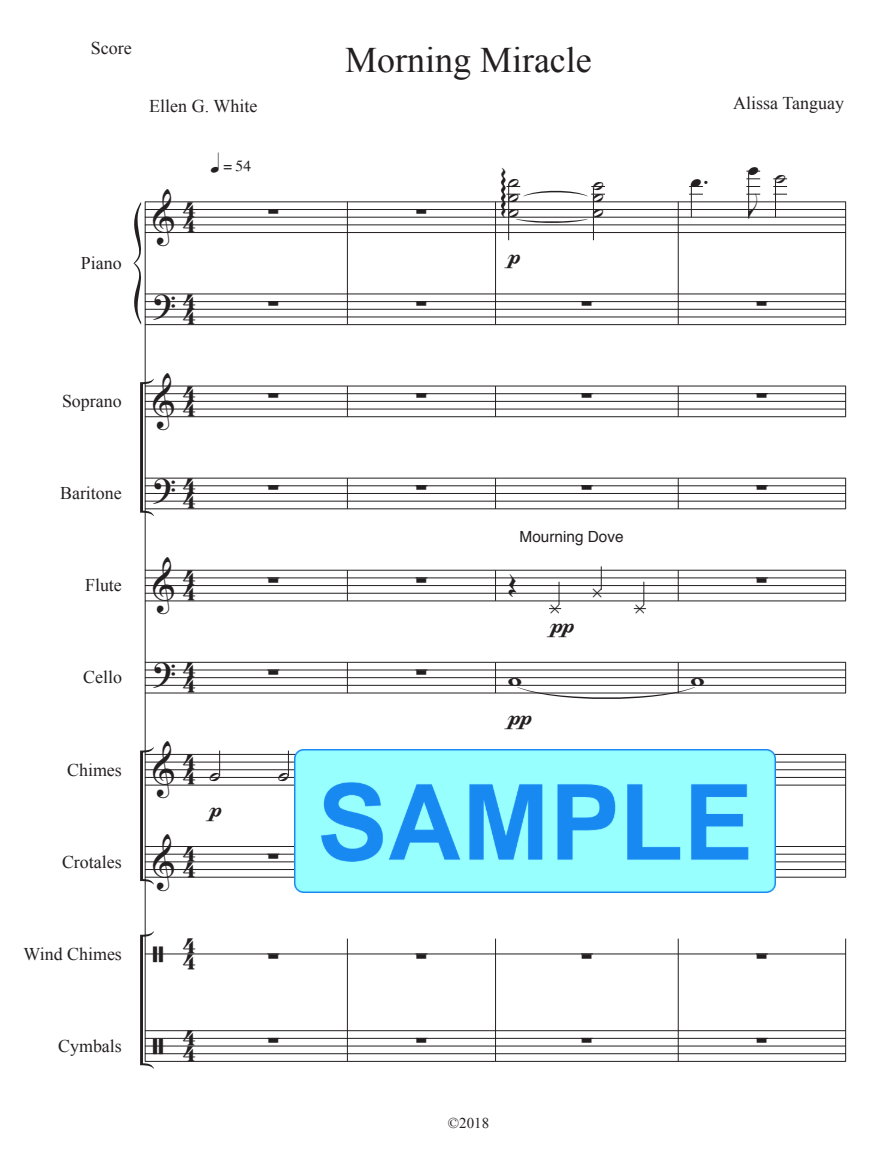
The opening of Morning Miracle in c minor with some added accidentals portrays the unsettling feelings that the composer imagines were felt by the Roman soldiers who guarded Jesus’ tomb. A special effect of this opener is the call of a mourning dove played by the flute to signify sadness. This section is also supposed to resemble a funeral march with the somber chime part, and the crotales add to the eerie mood. The split third chord in the piano part further haunts the listener. In this part, the cello acts as a solid bass, and then the flute comes in with a melody that seems unrelated, yet it helps tie all the instruments together while keeping the mood. Finally, the soprano enters and begins the verse. The text is taken from the pen of Seventh-Day Adventist author Ellen G. White (Early Writings – Chapter 43). Here, the words describe how and dark and gloomy the atmosphere was until an angel came from Heaven and “cried out ‘Thou Son of God, Thy Father calls Thee! Come forth.’” This is used for the chorus, and then the second verse and chorus parallel the resurrection with the 2nd coming of Christ. During the baritone solo, the piano has a chain of chromatic median and doubly chromatic mediant chords which serve the purpose of making the measures sound strange. The accompaniment builds through the key change to D major, and the chimes set the stage for the triumphant arrival of heavenly presence. Throughout the piece, the piano is the glue, setting new tempos, filling in sustained notes with faster arpeggios, and setting moods. The pianist has a great responsibility, as does the flute, whose part is a descant to that of the vocalists. There is text painting present in this piece, and one section in particular is during the baritone solo when the words are “then the earth trembled.” To show the trembling, the cellist plays tremelo, and the suspended cymbal has a roll. Everything flows quite nicely into another connecting slow passage which introduces the 2nd verse, and then the final chorus is upon the listener. Before the closing vocal section, there is a fermata which follows a suspension of a secondary dominant chord – V of ii. Then the soprano and baritone sing the second most important part (besides the resurrection), which is a good reason for most of the accompaniment to drop out. The words are “You have saved us with Your love, faithful Morning Miracle.” When they sing the last syllable of “miracle,” the accompaniment rejoins the scene in a similar fashion to the beginning with chimes, flute, cello, and piano. There is a split chord, which sounds like it could be the end, but then it resolves to a I chord arpeggio. This leads into a quintal chord that hangs in the air until it is resolved by the flute and piano to the note D. The ending is simple, portraying the idea that even though God has done so much for us, our choice is to either except or reject His loving sacrifice with simple faith, trust, and hope that we will see Him again someday soon.
The opening of Morning Miracle in c minor with some added accidentals portrays the unsettling feelings that the composer imagines were felt by the Roman soldiers who guarded Jesus’ tomb. A special effect of this opener is the call of a mourning dove played by the flute to signify sadness. This section is also supposed to resemble a funeral march with the somber chime part, and the crotales add to the eerie mood. The split third chord in the piano part further haunts the listener. In this part, the cello acts as a solid bass, and then the flute comes in with a melody that seems unrelated, yet it helps tie all the instruments together while keeping the mood. Finally, the soprano enters and begins the verse. The text is taken from the pen of Seventh-Day Adventist author Ellen G. White (Early Writings – Chapter 43). Here, the words describe how and dark and gloomy the atmosphere was until an angel came from Heaven and “cried out ‘Thou Son of God, Thy Father calls Thee! Come forth.’” This is used for the chorus, and then the second verse and chorus parallel the resurrection with the 2nd coming of Christ. During the baritone solo, the piano has a chain of chromatic median and doubly chromatic mediant chords which serve the purpose of making the measures sound strange. The accompaniment builds through the key change to D major, and the chimes set the stage for the triumphant arrival of heavenly presence. Throughout the piece, the piano is the glue, setting new tempos, filling in sustained notes with faster arpeggios, and setting moods. The pianist has a great responsibility, as does the flute, whose part is a descant to that of the vocalists. There is text painting present in this piece, and one section in particular is during the baritone solo when the words are “then the earth trembled.” To show the trembling, the cellist plays tremelo, and the suspended cymbal has a roll. Everything flows quite nicely into another connecting slow passage which introduces the 2nd verse, and then the final chorus is upon the listener. Before the closing vocal section, there is a fermata which follows a suspension of a secondary dominant chord – V of ii. Then the soprano and baritone sing the second most important part (besides the resurrection), which is a good reason for most of the accompaniment to drop out. The words are “You have saved us with Your love, faithful Morning Miracle.” When they sing the last syllable of “miracle,” the accompaniment rejoins the scene in a similar fashion to the beginning with chimes, flute, cello, and piano. There is a split chord, which sounds like it could be the end, but then it resolves to a I chord arpeggio. This leads into a quintal chord that hangs in the air until it is resolved by the flute and piano to the note D. The ending is simple, portraying the idea that even though God has done so much for us, our choice is to either except or reject His loving sacrifice with simple faith, trust, and hope that we will see Him again someday soon.